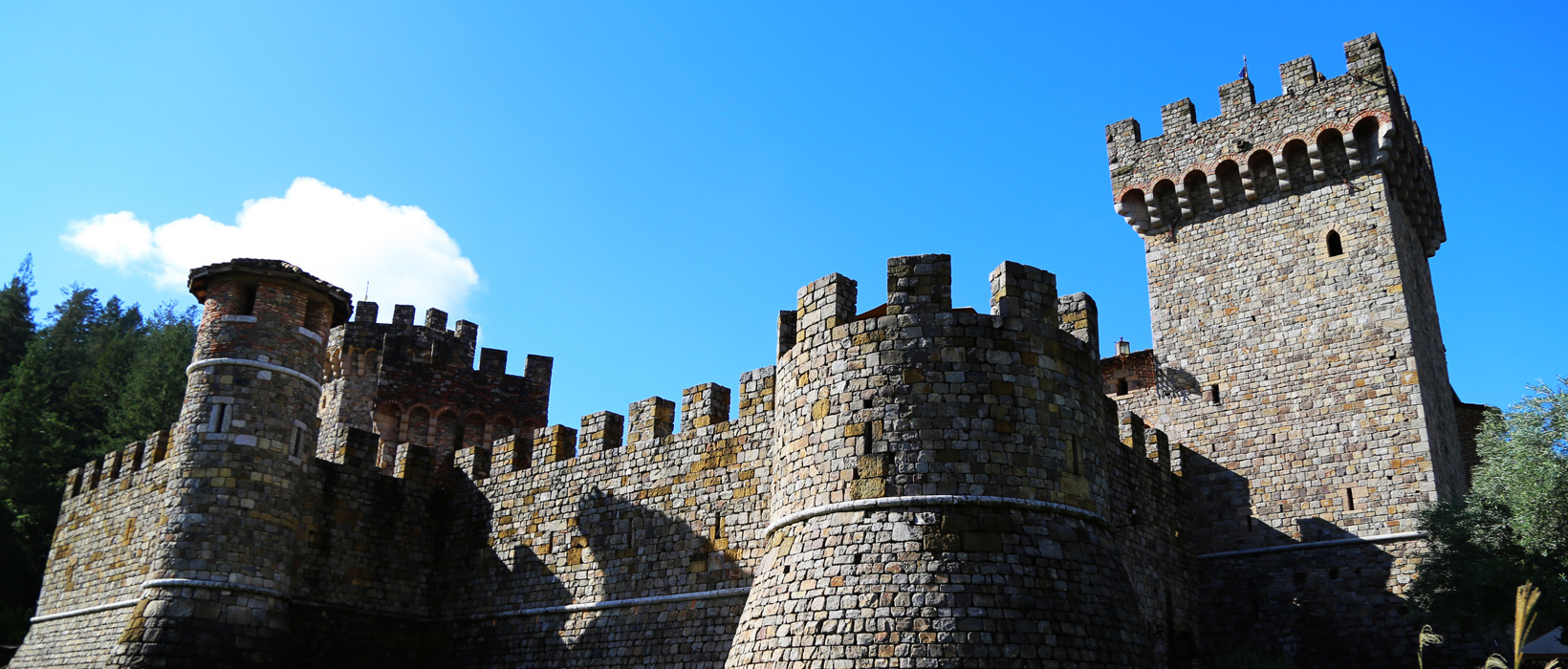
On Location – Castello de Amorosa
Castello di Amorosa offers a rich blend of old-world charm and cinematic elegance. The estate features grand stone architecture, iron gates, winding staircases, and hidden courtyards—every corner dripping with visual drama and romantic detail. Surrounded by rolling vineyards and bathed in the warm light of Napa Valley, the castle provides a storybook setting ideal for fashion editorials, engagement sessions, or fine art portraits. The interior, with its candlelit great hall, vaulted cellars, and antique decor, adds depth and atmosphere to every shot. Shooting at Castello di Amorosa feels like stepping into another time and place—an enchanting fusion of California wine country and medieval Europe.


History
Castello di Amorosa, located in Napa Valley, California, is a striking replica of a 13th-century Tuscan castle and one of the region’s most unique wineries. The vision of fourth-generation winemaker Dario Sattui, construction began in 1994 and took over 15 years to complete, opening to the public in 2007. Built using traditional medieval techniques and over 8,000 tons of hand-chiseled stone, the castle features authentic elements such as a drawbridge, moat, dungeon, chapel, and 107 rooms — most dedicated to winemaking and wine storage. While it evokes the romance and grandeur of Old World Europe, Castello di Amorosa is firmly rooted in Napa’s viticultural tradition, producing premium Italian-style wines from estate-grown grapes. The castle not only reflects Sattui’s passion for history and architecture but also serves as a testament to the fusion of old-world craftsmanship with California’s renowned wine culture.


Stone and Silence: A Photoshoot at Castello di Amorosa
The road into Napa Valley was drenched in gold and green vineyards stretching like patterned tapestries, hills rolling in soft waves. But as I approached Castello di Amorosa, the energy shifted. The castle didn’t just rise out of the landscape—it loomed, as if time itself had been interrupted by its presence.
A 13th-century Tuscan castle in the heart of California wine country is already surreal. But arriving before the crowds, just as dawn cracked over the hills, turned the surreal into something spectral. The silence was heavy—not empty, but ancient.
Mist still clung to the vineyards like forgotten lace, curling around the stone towers and iron gates. My first photo was taken before I even stepped out of the car—framed by the windshield, the castle looked like a dream about to disappear.


Once inside the gates, the stillness deepened. There was no music, no voices, no signs of life save for a single raven perched on a weathered gargoyle, watching me. Its cry cut across the silence like a warning—or maybe a welcome.
I moved through the stone corridors slowly, my footsteps echoing as though I wasn’t alone. Arched ceilings, candlelit sconces, medieval tapestries, and wrought iron chandeliers—all designed with obsessive authenticity—gave the place an otherworldly chill. It didn’t feel like a replica. It felt transported.
In the great hall, shafts of morning light broke through stained glass, painting fractured reds and blues on the cold stone floor. My camera lens caught it all: the quiet grandeur, the dust hanging motionless in the light, the way every detail seemed suspended in time. It wasn’t just beautiful—it was haunting.


Outside, the vineyards framed the castle in long, symmetrical lines—a kingdom lost in wine and silence. From the towers, I could see the valley waking up below, fog rising from the earth like spirits returning to the sky. No sound but the wind through cypress trees and the distant hum of a world not welcome inside these walls.
I spent hours moving through the castle’s chambers and battlements, every turn revealing another untouched moment. The dungeon, dim and eerie, was a stark contrast to the open courtyards blooming with lavender. Beauty and menace—side by side.
By the time the first tour groups arrived, I was done. The spell had lifted. Laughter and footsteps replaced silence, and the castle returned to being a destination instead of a dream.
As I drove away, the images I’d captured played in my mind like scenes from a forgotten legend. Castello di Amorosa wasn’t just a backdrop—it had been a character, a presence, a whisper from another time.
Some places don’t just exist—they remember. And if you arrive early enough, quiet enough, they let you remember with them.


