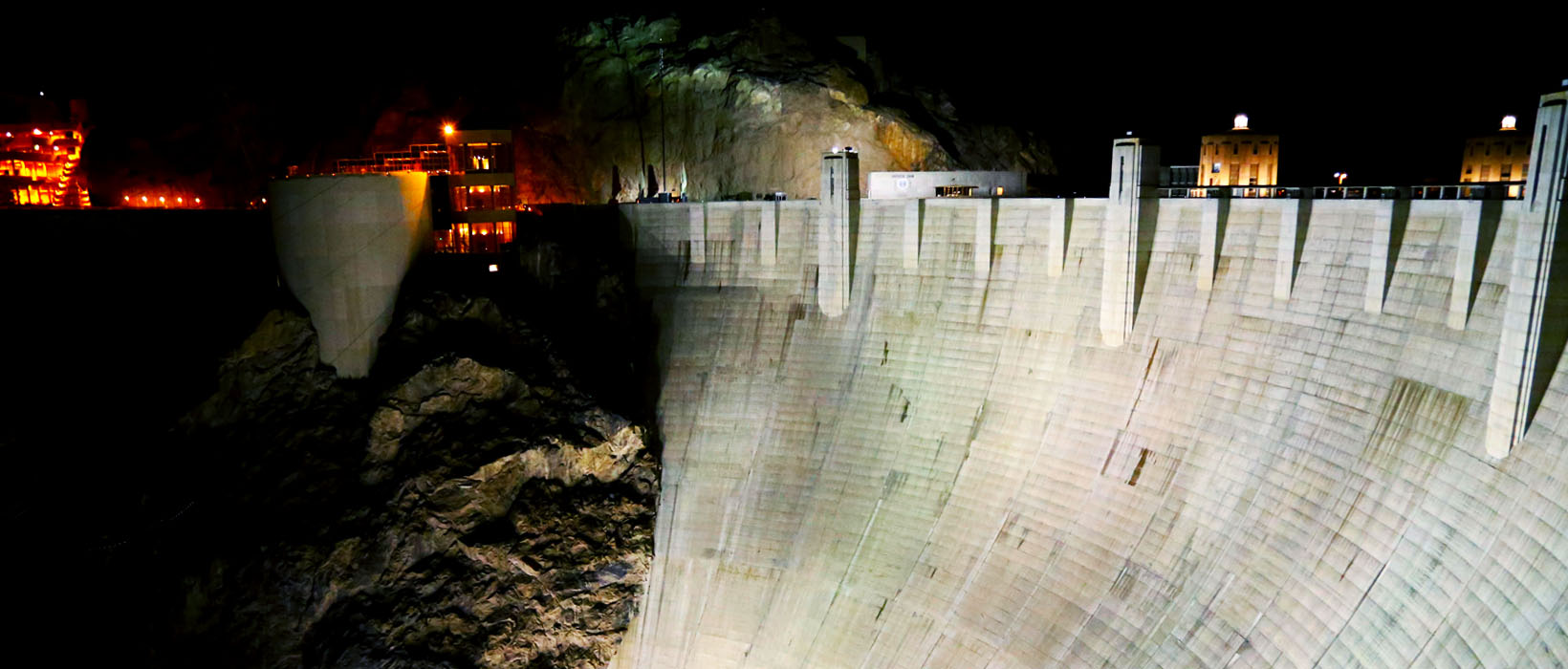
On Location – Hoover Dam
Under the cloak of night, the Hoover Dam transforms into a breathtaking monument of light and shadow, making it an ideal subject for an on-location photoshoot. The towering intake towers and the sweeping curve of the dam itself are dramatically illuminated, casting reflections across the still waters of the Colorado River below. With the hum of the turbines muffled by distance and the stars overhead providing a cosmic backdrop, the scene blends industrial grandeur with natural serenity. Shooting at night allows for long exposures that capture the subtle glow of the structure, the twinkle of nearby city lights, and the sheer scale of the dam as it cuts through Black Canyon. The absence of crowds lends a haunting, almost sacred quality to the experience—perfect for photographers seeking atmosphere, contrast, and iconic American symbolism.


History
The Hoover Dam, one of America’s most iconic engineering feats, was constructed during the Great Depression to harness the power of the Colorado River and provide water and hydroelectric power to the rapidly growing Southwest. Originally called Boulder Dam, it was later renamed in honor of President Herbert Hoover, who played a key role in its development. Construction began in 1931 and was completed in 1936, two years ahead of schedule, employing thousands of workers during a time of massive unemployment. Built by the consortium Six Companies, Inc., the dam created Lake Mead, the largest reservoir in the U.S. by volume. The project not only revolutionized infrastructure and water management in the arid West but also stood as a symbol of American resilience, ingenuity, and the transformative power of federal public works programs during a time of national hardship.


Shadows and Silence — A Night at Hoover Dam
The road curved through black desert like a ribbon of ink. I drove with the windows down, the warm Nevada air pressing in, heavy with the scent of dust and concrete. It was just past 10 p.m., and the world felt hushed—like even time had pulled over to admire the stillness. The stars above were crisp, undiluted by city haze. And there, rising from the canyon like some enormous Art Deco fossil, was the Hoover Dam.
I pulled into the lower lot beneath the spillways, where the echoes of the Colorado River whispered between slabs of concrete and steel. The dam was lit, but barely. Floodlights painted it in stark contrasts—ivory walls, sharp shadows, industrial halos. It looked less like a public utility and more like a fortress from another age.
I got out and shouldered my gear. The night air was warm, but dry enough to feel clean. Aside from the distant hum of generators and the occasional rumble of a truck on the bypass bridge above, it was silent. No tourists. No families. Just me, the dam, and 726 feet of engineered gravity defiance.
I started with wide shots. Long exposures picked up more than my eyes could see—stars winking faintly behind the silhouette of the intake towers, the golden wash of lights reflecting in the inky reservoir. The bridge arched above in the distance, like a backbone to some colossal beast.
But it wasn’t just the visuals. There was a presence to the place at night. A weight. You feel it in your chest. Maybe it’s the scale, maybe it’s the pressure of the river behind that concrete, or maybe it’s just the ghosts of all the men who built this thing with pickaxes and dynamite, some of whom never left.
At 10:30 a.m., I moved to the Arizona side, across the dam. No wind. No people. Just the soft rhythmic sound of water moving hundreds of feet below, like the earth breathing in its sleep.
I set up a new angle—framed one of the intake towers in the foreground, with the curvature of the dam sweeping behind it. The structure seemed to glow from within, like some dormant engine waiting to wake up.
I stood still for a moment. No shutter clicks. No adjustments. Just stillness. The dam was timeless in that hour—less a man-made marvel than a monument to the impossible. This place wasn’t built, it was willed into being. You could feel that.
At some point, around 11:30 a.m., I started shooting upward, toward the Mike O’Callaghan–Pat Tillman Memorial Bridge. I caught its arch slicing across a sky now thick with stars. A semi-truck passed above, its lights streaking through the frame like a comet. Accidental, but perfect.
I was nearly out of memory cards. My feet ached; my hands were cold despite the heat radiating from the concrete. But I wasn’t ready to leave. I walked back to the center of the dam, leaned against the railing, and looked down.
Blackness. Movement. A sense of something ancient below. I shot a photo.
Eventually, the sky in the east began to tint faintly blue. Not quite sunrise—but the kind of shift you feel more than see. I packed my gear, gave the dam one last look, and whispered something like thanks. For letting me be here. For still standing.
Driving away, the headlights caught nothing but road and shrubs. But in my rearview mirror, the dam still loomed, aglow in amber light. Silent. Immense. Eternal.


